Friday, March 12, 2010

Insight -- That flash of inspiration.


I am always on the lookout for problems that do a reasonably good job of demonstrating either the left-brain ‘follow the rules’ thinking, or right-brain flash of insight thinking, or both. People who are great problem solvers are good at both. (In Advantage I talk about people who have this capability in spades - supersynthesizers.)


It is also nice to find a problem where the solution is elusive until the moment you see it, then it is obvious.


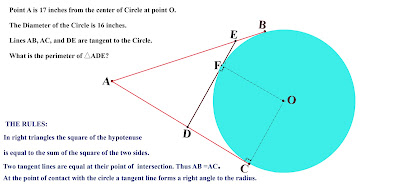
The problem below is such a problem. The solution to the problem below requires a flash of insight. I will post the flash of insight tomorrow. If you make a comment, please don’t give

away the flash of insight.


Saturday, March 6, 2010


(An excerpt from “Advantage: Business Competition in the New Normal”)


The Value of Knowledgeable Novices


History and experience suggest that the right novice well placed is sometimes the best way to solve a problem. Novices come at a problem without any of the mental moats the expert is unable to ford.

Theoretical physics is a great example. It has long been the domain of the novice. In this context, a novice isn’t someone who lacks knowledge, but, rather, someone who has not yet embraced a point of view or repeated a behavior frequently enough to have ossified a brain pattern. Einstein was just such a novice when he published his four landmark papers in 1905. Most of his thinking at that time was done independently although not always alone. He verbalized ideas to others but was often just talking to himself. It was serendipitous that, while working at the patent office, he reviewed a patent application dealing with the transmission of electric signals and electrical-mechanical synchronization of time. These became the fodder for his thought experiments, which led to his revolutionary insights into the nature of light and the basic link between space and time. He was a novice in the sense that he’d not adopted a point of view; nevertheless, he was very knowledgeable in his field.


In many fields where synthesis is the key to new knowledge, often it is a novice who delivers the breakthrough. In physics and mathematics, PhDs worry as they approach their thirtieth birthdays that they are rapidly losing the opportunity to come up with something truly revolutionary. The notion is that their brains ossify around the knowledge they have and that limits their ability to see something new. This is true in every human endeavor. We should try to leverage this insight in a business context.


When a business faces a problem, using a novice will bring a fresh perspective. What kind of novice do you want? Preferably you want someone with the capacity to see the big picture and who has good synthesis skills. Perhaps you should use someone with a history of problem solving (as distinct from someone who is just good at project delivery). Find someone with a broad set of curiosities who can easily get sidetracked trying to get to the bottom of something. Find someone with all these characteristics, and you have a good chance at getting a fresh perspective on the problem. Don’t be surprised if the experts closest to the problem think the novice has it all wrong. It took about four years for physicists to stop rejecting Einstein’s ideas expressed in his four 1905 papers.


1 The Novice Supersynthesizer™ is a person who possesses extraordinary problem solving skills but has not absorbed a mindset around the problem at hand.


Tuesday, March 2, 2010

The Peak Interview

Why would a consulting firm like Launchpad Partners that has nothing to do with employment, outplacement, recruitment, retention or HR consulting produce a book like The Peak Interview?

Launchpad Partners consists of a handful of highly seasoned executives who’ve been leaders of innovation throughout their careers. A principal way they help clients is to assist in synthesizing their next competitive advantage. They wanted a strong example of the results of their methodology. While they have lots of examples of this, the trouble with developing a new business model or product or service for a company, is that it usually looks ridiculously obvious in hindsight. This phenomenon of perception undermines real value of what they deliver. Therefore, they wanted something that would give people a better opportunity to evaluate what they’re capable of doing.


The Job Interview is something everyone in their target audience understands. Most executives have been on both sides of the interview. Moreover, the job interview is something millions of people go through every year and each one of them is looking for competitive advantage to win the interview and get the job offer. More than that, there are thousands of employment professionals advising clients on how to win the interview. The reason this is a good demonstration of Launchpad’s process is that you’d think with all these professionals working on this, every stone would have been overturned and nothing new could be found. Launchpad's process demonstrates that substantial new competitive advantage can be found, even in this unlikely scenario.


The book The Peak Interview describes this competitive advantage. Here is its promo:


The Peak Interview


New insights into the job interview process can give you an edge to win the interview and get the job. By the time you get to the job interview, the company has determined you are qualified for the job. But so are all the other interviewees. Your experience, skills, competencies, and abilities will not differentiate you. Your competition is just as qualified as you are. You need an edge.


Great jazz soloists know that when they are playing a solo, they have to hit one or two peaks in the body of the solo and end with a flourish. That's because people evaluate an experience based on its peaks (good or bad) and how the experience ended. The rest of the experience is remembered, but the evaluation of the experience is based on its peaks, and how it ends. This is called the ‘Peak/End rule’.


Psychologist Daniel Kahneman is credited with describing this rule. His insight had such a big impact on the study of economics, that he won the 2002 Nobel Prize, despite the fact that he is a psychologist who has never taken so much as a single economics course. When people assess a past experience, they attend to two things above all: how it felt at the peak and whether it improved or worsened at the end. It is important to recognize that everything else isn’t forgotten, it just isn’t used in how we judge the quality of the experience. That means we make decisions, not on a rational basis that fairly evaluates the whole experience, but rather on the peaks and especially on the ending. On this basis we can actually make choices which, on a purely rational basis, don’t make sense.


The Peak Interview emphasizes all the best practices you need to skillfully deliver in the interview, but then shows you how to leverage the Peak/End phenomenon as you prepare for, and produce an outstanding interview. This insight can boost your chances of winning the job.

Saturday, February 27, 2010

C.R.A.P.

(An excerpt from “Advantage: Business Competition in the New Normal”)

C.R.A.P.

Our brains have the automatic ability to see some solutions with a mental snap. It is the moment of insight that magically seems to pop into our brains. If you are a native English speaker, you may experience that snap with the following. (Apologies to those of you who are less familiar with English.) Compound remote associate problems, or C.R.A.P., are used for fascinating brain research by Mark Jung-Beeman at Northwestern University. He and Edward Bowden have compiled a list of these puzzles based on how quickly people get them. The puzzles involve word association. For example, what word is associated with each of these three words: man/stop/wrist? The answer is watch, as in watchman, stopwatch, and wristwatch. Try these four, each with a different answer:

cottage/swiss/cake

rocking/wheel/high

cream/skate/water

show/life/row

Chances are, with at least one of these, you experienced a brain snap, where the answer (cheese, chair, ice, boat) just popped into your head. It’s a little weird because it’s as if your brain does something that you really don’t control or understand. That is why we say our mind seems to automatically find the solution. Neuroscientists like Beeman have done very interesting work in trying to understand what is taking place in the brain when we have these brain snaps, or when we take a bit longer to solve a puzzle. You may find with the following puzzles that you feel more like you are in control of the process. Most of us don’t get these easily if at all. If you get even one, you’re doing better than I did.

reading/service/stick

shadow/chart/drop

land/hand/house

cast/side/jump

Here you may have found yourself doing a great deal more searching, going through the catalogue in you mental dictionary of all the words that are associated with each of the words in the four puzzles. You are trying to force the synthesis through this knowledge review. The answers are...(in the book, of course)


Get a copy by clicking: Advantage: Business Competition in the New Normal

Wednesday, February 24, 2010

(An excerpt from the new book: “Advantage: Business Competition in the New Normal”)


Mindset Revisit


Sometime the point of view is so rigid that the person will be incapable of seeing the issue from a different perspective.


Another joke:


A man showed up at a psychiatrist’s office worried.

“Doc,” he said. “I am worried about my family.”

“Why is that? asked the doctor.

“Well, it seems they are having a hard time accepting the tragedy of my death,” the man replied.

“Oh, I am sorry,” responded the doctor. “Are you terminally ill?”

The man frowned at the psychiatrist. “Why? Do I look sick? No, I’m not sick. I’m dead!”

Surprised, the psychiatrist said, “Did you say you’re dead?”

“Yes,” replied the man. “Quite and completely dead!”

Intrigued, the psychiatrist invited the man to sit on his couch.

“So, you’re dead, you say,” inquired the doctor. “How long have you been dead?”

“Well,” replied the man. “I’ve been dead most of my life, so to speak, since I am not really alive.”

“Let me ask you something,” said the psychiatrist, thinking. “Do dead people breathe?”

“No, don’t be stupid. Of course dead people don’t breathe,” replied the dead man.

“Well, I have news for you,” said the doctor triumphantly. “Clearly you’re breathing, so you cannot truly be dead!”

“Oh, No! No!” laughed the man. “I am only pretending to breathe. It’s a habit because not breathing tends to alarm people around me.”

“Ah, I see,” the doctor scratched his chin thoughtfully. “Well, do dead people’s hearts beat?”

“Come on,” answered the patient. “You know the answer to that. Of course dead people’s hearts don’t beat.”

The psychiatrist walked over to his desk and pulled a stethoscope from a drawer, put the earpieces into his ears, and listened to the man’s chest. “I hear a heartbeat,” he said, raising his eyebrows to the dead man.

“Oh, that is just a sound I make. It’s a habit like breathing,” replied the man.

The doctor retuned to his desk, put the stethoscope away, and surreptitiously picked up a pin.

“So, if your heart is not beating then you would have no blood pressure, and you would not bleed?” he asked the patient.

“No! Of course not, dead people don’t bleed,” he said emphatically.

“Are you sure?” asked the doctor.

“Absolutely.”

“If you got a cut, would you bleed?

“Look,” replied the man impatiently. “Don’t be thick about this. You know perfectly well I would not!”

Instantly, the doctor grabbed the man’s finger and pricked it with the pin. Blood oozed out of the hole.

“Ah, ha!” exclaimed the doctor. “You see, you do bleed. You’re alive!”

The man looked at his finger in bewilderment and then looked at the doctor with astonishment.

“Well, what do you know,” he said throwing his hands up. “Dead people do bleed!”


A point of view can create a powerful bias.


pastedGraphic.pdf

Purchase the book: Advantage: Business Competition in the New Normal


Monday, February 22, 2010

(An excerpt from “Advantage: Business Competition in the New Normal”)

(An excerpt from “Advantage: Business Competition in the New Normal”)


Perhaps one of the most dramatic examples of mindset is what happened before Einstein came up with his theory of relativity. Newtonian physics says that if you are standing still and throw a ball with a certain force X, it will leave your hand at fifty kilometers per hour. Likewise, if you are standing on a train going sixty kilometers per hour, and you throw the ball with the same force X, it will leave your hand at one hundred ten kilometers per hour (fifty + sixty). In 1887, E.W. Morley and A.A. Michelson decided to measure the difference between the velocity of light as it is beamed with the speed of the rotation of the earth pushing it and as it is beamed perpendicular to the rotation of the earth. The idea was that the light beam that has the speed of the earth’s rotation behind it must be going faster than the light beam that does not have that incremental speed behind it. To their surprise, no difference was detected. The scientific community knew there was something was wrong with the way they did their experiment because you cannot violate the laws of physics. It perplexed scientists for years because they couldn’t find the error.


Is this so surprising? One possible explanation is that the earth is not rotating. “WHAT?” just went through your brain didn’t it? The certainty we have about the earth rotating is the same certainty those scientists had about Newtonian physics. They could not have contemplated the alternative.


Recognizing facts is essential to getting the problem right, but point of view can color the evidence and cause us to interpret the evidence in a way that’s consistent with our worldview. It is a phenomenon that has been noticed and written about repeatedly in business and psychology texts. It is often expressed as being too close to the problem and, thus, not able to see it clearly. Einstein said, “What does a fish know about the water it swims in?”


When Albert Einstein looked at the Michelson-Morely velocity of light results, he thought to himself, ’What if the results of the experiment are correct?’ What Einstein did was step back from the problem. If the evidence proved correct, that would mean Newtonian physics was wrong. This heresy opened the universe to a new point of view and changed physics forever.


Purchase a copy: Advantage: Business Competition in the New Normal
Sunday, February 21, 2010

Analysis Can Actually Hide The Problem

Analysis is the act of discovering what existing knowledge we have about a particular object or problem.


Analysis is the process we go through to define a problem. If we are going to err in coming up with the solution that gives us competitive advantage, then the obstacle hides here. Why is that?


Often, when we go through this problem definition process we start with something like “Let’s lay out what we already know.”


Unfortunately, the way the human brain works, when we are very familiar with a topic or product group, or process, or business model, our brains have already gone through a process of efficiency. Our brains determine what is relevant, and what can be ignored. It blocks out the stuff that is not relevant to the enterprise. This gives the brain the best opportunity to focus on what is relevant.


A simple example of this is when you are holding a conversation in a busy coffee shop. You can have this conversation because your brain allows you to ignore: the music playing from the sound system; the activity behind the counter as the baristas make their drinks; a staff member going around cleaning up tables and straightening newspapers; the fire burning in the fireplace; traffic zooming by outside the window, other patron’s conversations near by, and many other stimuli.


Unfortunately it is in the space that the brain is ignoring that the opportunity hides. If you are too close to a problem it is because “what you already know” will not include the subtle changes that make your product, process, business model, etc., less competitive.


It helps if you start with “Let’s lay out what we already believe, recognizing that the truths we hold dear may be missing the mark.” But really, the only way to avoid this frequent and debilitating problem is to bring in a novice brain. The best brain for this is the supersynthesizer brain. You want a supersynthesizer who is broadly knowledgeable but knows little about your problem.